February 11, 2022

What's in a Grow Tent? The Science and Tools Behind Keeping Indoor Bonsai Healthy

Source material: November 21, 2021

        While we're on the subject of my latest Youtube ventures such as the Todd Schlafer demonstration I posted on the Columbus Bonsai Society's new Youtube channel last week, I wanted to also take a moment to share another recording from a recent CBS Meeting. Last November while the final few deciduous leaves were falling in Ohio and the first nightly frosts were appearing, CBS held a meeting focused on preparing trees for winter. One of our seasoned members lectured on how to protect outdoor bonsai over winter and I volunteered to present on preparing an indoor space for your tropical bonsai over winter. Given my background in academia and in science, my lecture focused on the biology of tropical trees, the physical aspects of tropical environments compared to the conditions inside typical homes, and how we can improve those conditions to help our trees grow better. Although many parts of the northern hemisphere are already exiting winter, for many apartment-dwelling bonsai hobbyists or those who otherwise are only focused on indoor growing, this lecture will be relevant at any time of year. A tree growing indoors on a windowsill will simply never grow at its full potential unless we supplement things like light, humidity, airflow, and warmth. You can watch the full lecture below to learn more about how you can improve the health of your indoor bonsai and develop them faster. I'll include some additional details at the end of the article including the exact products I've used in the past just to give you an idea of the possibilities.

Sections

  1. Full Lecture - Time-Saving Tools for Growing Tropical Bonsai Indoors
  2. Supplies to Improve Indoor Growing
    1. My starter supplies:
    2. My current supplies with grow tent:
    3. Current setup with pictures:
  3. Blog Announcements
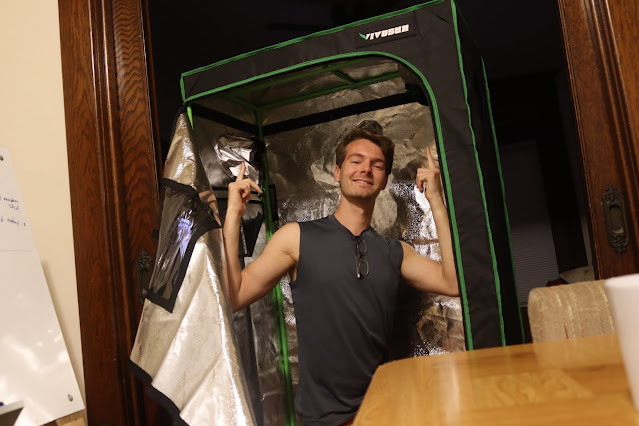
Apparently, I'M in a grow tent! But seriously, read on to see what type of lights I've been using. This picture is from when I first got my grow tent in the fall of 2020. I have definitely noticed it helped my tropical trees stay happier in winter.

February 4, 2022

Todd Schlafer Finds the Trunkline - Columbus Bonsai Society Full Demo

Source material: 10/17/2021

        Hello all! Just wanted to share quickly one of my recent online bonsai projects. Similar to what I did during my time with the Puget Sound Bonsai Association's DVD archive, as part of my role as the librarian for the Columbus Bonsai Society, I'm starting a CBS Youtube channel and uploading their meetings for all to see! Please enjoy the first video on their channel featuring a demonstration by Todd Schlafer of First Branch Bonsai. Based out of Denver, Todd is now one of the most in-demand traveling bonsai artists due in part to his training with Ryan Neil and extensive experience with collecting and styling native species from the Rocky Mountains.

        The before and after photos can be seen in the first 20 seconds of the video. I found myself amazed by the tree that Todd found inside that challenging raw stock. There's a good lesson in there on how to simplify a complicated piece of raw stock, but Todd also discussed many other topics at length during this demonstration such as fungicide use, how he got into bonsai, how he decided to become a bonsai professional, and next steps for this tree such as how to care for a tree styled in late fall as the growing season is ending.

December 7, 2021

Refining the 2-In-1 Step Method for Kintsugi Ceramic Repair

        Last time I gave y’all a thorough review of 6 different kintsugi methods you can choose from based on the needs of your pot-mending situation. After completing this review, out of respect for my current situation as a graduate student with limited time and funds, I opted to try one of the simplest methods - the "2-in-1 Step Method: Oozing Colored Epoxy". As I previously described, this method requires the least supplies, hands-on steps, and wait time while providing a durable end product. Because this method had concerns regarding control of the aesthetic quality, my next question was whether these limitations could be improved upon. Hence, today's article covers several trial pots I repaired with this method to observe and tweak the 2-in-1 Step technique. My results from the final pot I repaired (see below) advance the 2-in-1 Step Method as it demonstrates the ability to use this method to cleanly fill large missing pieces in some circumstances, which has not previously been reported. Combined with the careful application of the colored epoxy, this technique may now be closer to the quality associated with the more complicated kintsugi repair techniques.

        My recommendations for an improved 2-in-1 Step protocol can be found at the end of this article.
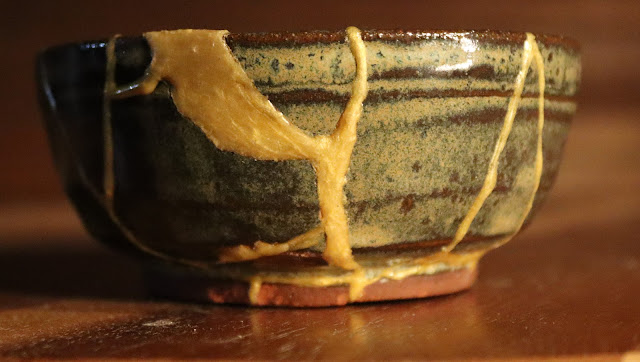
    The result of my final kintsugi repair using the 2-in-1 Step Method: Oozing Colored Epoxy.
    This piece had a large missing piece and some small gaps from smaller missing pieces which made it extra challenging for this technique.

    October 26, 2021

    Broken Bonsai Pot? No Problem! Modern Methods for Ceramic Repair Through Kintsugi

               Whether from poor packaging or handling during shipping, a strong wind, a pet-related accident, or just our own clumsiness, everyone in bonsai eventually has to deal with the frustration of a broken bonsai pot. If you found this article because this recently happened to you, don't despair. You do have options. You could repair the pot so the cracks from its catastrophe are barely visible, but in the esoteric world of bonsai aesthetics, generations of Japanese ceramics before us have developed a more artistic way to mend broken pots - this is the process known as kintsugi. 
            This article began from my own research into methods of kintsugi repair so I could repair one of my broken pots.  Like in other areas of bonsai, there is a centuries-old, established, traditional technique but there are also more modern methods that can make the process of mending pots faster, simpler, and cheaper. The objective of this article is straightforward - find step-by-step information that is doable for an amateur (like me), and then narrow down potential methods by expected durability, quality of end product, time to complete the repair, cost of materials, and convenience to locate said materials. To evaluate this list of considerations, I summarized the pros and cons of each method according to my findings and interviews with people who have tried each technique (See the summary table at the end for the short version). Finally, I modified the winning kintsugi repair protocol for use on my pot and I will share that process & result next time.

    August 13, 2021

    Crazy for Catalpa! Bonsai prospects for an unusual North American native

             If you're familiar with the northern catalpa, Catalpa speciosa, then you know it's a pretty strange tree and certainly not one which you would expect to be used for bonsai. Maybe it's a fool's errand for me to attempt to tame a tree with 12" leaves and 20" seed pods, however something about that staccato, memorable name has got me captivated. I've been observing specimen of it everywhere I go around Columbus as it is one of the more easily identifiable naive trees around - so much so, I've even got my girlfriend shouting "Catalpa!" every time we pass one. From this foundation, basic identification skills had led me to observe the species more intimately. As with any unknown species, the more scenarios you observe a specimen, the more you can observe its potential for bonsai. In the case of the catalpa, observations of a full-sized specimen, the seeding frequency of seeded, the fast growth of those volunteers, and the discovery of one naturally stunted catalpa all inform my plans to experiment with this species for bonsai.

     Sections

    Catalpa is capable of producing a variety of leaf sizes. The left-most leaf is typical for a healthy catalpa, while the right leaves are from a naturally stunted catalpa.