Showing posts with label Bonsai Pot. Show all posts

March 8, 2023

Repotting Scenarios for a Shohin Privet and Intro to Bonsai Soil

Source Material: March 02, 2023

             Welcome back bonsai enthusiasts, today I share a short article focused on a recent repot which illustrates some larger questions we must ask for our trees to look their best. Where should I position my tree in the pot? To the center? To the left? To the right? How do I want the nebari/root flare to look given the options the tree provides? Read on for a closer look at the unique challenges and character of this tree, think through what you would have done if it was your tree, and feel free to share those ideas in the comments below.

Sections:

  1. Reviewing Repotting Basics
  2. History of the Tree
  3. Nebari Decisions
  4. Planting Position - What Fits Best?
  5. Final Result
  6. Announcements

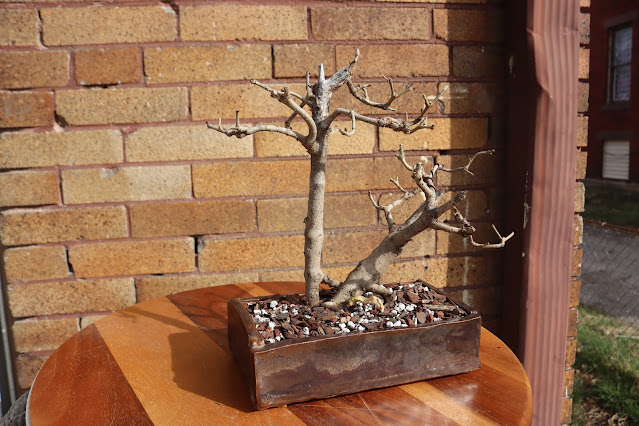
The final product of our repot. March 2023. The pot is from Ancient Art Bonsai by Mark Passerrello.

August 10, 2022

Moss Collection & Preparing Your Tree for Show! July CBS Lecture by Kevin Faris

Source material: July 17, 2022

            For the most recent Columbus Bonsai Society monthly meeting, we had a short opening lecture focused on show preparation - led by our own Kevin Faris - followed by some "Bring-Your-Own-Tree" Workshop time. As part of our efforts to help members prepare for the upcoming 50th Annual CBS Show, Kevin focused on the specifics of collecting moss, the benefits of moss, applying moss for show preparation, and as a bonus, he even covered why and how to oil pots before you show your trees. We look forward to seeing everyone's trees in just over 1 month on September 24th-25th at Dawes Arboretum! Remember to check www.columbusbonsai.com to register in advance for workshops or special lectures you want to attend as some of them have limited space.

Find the full lecture here.

August 1, 2022

Reflections from April Grigsby, an American Potter's Journey - Bonsai Time Podcast Ep 07

            In the seventh episode of the Bonsai Time Podcast, my co-host Kevin drove to meet April Grigsby of April Grigsby Ceramics in NE Ohio. April Grigsby is a relatively new American bonsai potter on the scene; you can arrange to visit her studio in person through the contact info on her website. They discussed April's diverse background in art and bonsai which has today led to the start of her successful bonsai pottery business. She now travels to many local midwestern shows to sell her handmade traditional Japanese-inspired pots and was even invited by Bill Valavanis to sell at the recent 2021 US National Bonsai Exhibit. Hear some of her special tricks and the work that goes into the pots which are so important to showcasing our trees. Enjoy!
    Note: April is one of several prominent bonsai artists who will be in attendance at the upcoming Columbus Bonsai Society 50th Annual Show taking place in September. See here or www.columbusbonsai.org for more information.


Listen to the episode on Youtube.

Or, listen to the episode in your podcast app of choice.

October 26, 2021

Broken Bonsai Pot? No Problem! Modern Methods for Ceramic Repair Through Kintsugi

           Whether from poor packaging or handling during shipping, a strong wind, a pet-related accident, or just our own clumsiness, everyone in bonsai eventually has to deal with the frustration of a broken bonsai pot. If you found this article because this recently happened to you, don't despair. You do have options. You could repair the pot so the cracks from its catastrophe are barely visible, but in the esoteric world of bonsai aesthetics, generations of Japanese ceramics before us have developed a more artistic way to mend broken pots - this is the process known as kintsugi. 
        This article began from my own research into methods of kintsugi repair so I could repair one of my broken pots.  Like in other areas of bonsai, there is a centuries-old, established, traditional technique but there are also more modern methods that can make the process of mending pots faster, simpler, and cheaper. The objective of this article is straightforward - find step-by-step information that is doable for an amateur (like me), and then narrow down potential methods by expected durability, quality of end product, time to complete the repair, cost of materials, and convenience to locate said materials. To evaluate this list of considerations, I summarized the pros and cons of each method according to my findings and interviews with people who have tried each technique (See the summary table at the end for the short version). Finally, I modified the winning kintsugi repair protocol for use on my pot and I will share that process & result next time.